Frequently Asked Questions
On this page, I discuss some of the questions often asked about Wuthering Heights and give my views on them.
Where did Heathcliff go?
(and where did he get his money?)
When Heathcliff fled from Wuthering Heights in 1780, he had little education and no money. He returns three years later having acquired both. How did this come about? Education can be bought or self-taught so the real question is where he found his money. Ellen's suggestions are that he went abroad:
It was a deep voice, and foreign in tone; yet there was something in the manner of pronouncing my name which made it sound familiar.
and that he was in the army:
Have you been for a soldier?
and
His upright carriage suggested the idea of his having been in the army.
 Between 1780 and 1783, Britain was involved in the American War of Independence which was drawing to its end while on the Continent was the minor War of the Bavarian Succession. So there was no major war to benefit from, either as a Briton or a mercenary. Without education and contacts (and only 16 at the beginning), he would have found it difficult to rise in the ranks and there would have been little money except from plunder. Heathcliff is also quite evasive about this although it would be a fairly respectable explanation.
Alternative explanations for his remarkable rise are that he was involved in the slave trade (which did not end in Britain until 1807) and, alternately, just simple criminality. In my view, the slave trade would seem the best explanation. It would explain his reticence in revealing his past, his foreign pronunciation, and would also fit his character. (Heathcliff does mention slavery in chapter 11 – "The tyrant grinds down his slaves and they don't turn against him; they crush those beneath them" – but this cannot be taken as proof of his past.)
How could Emily Brontë write Wuthering Heights?
 Many commentators, especially Emily's contemporaries, found it hard to believe that a reserved clergyman's daughter with little experience of the world could have written such a unique, brutal and immoral (as they saw it) novel. At the time, many assumed that the author was a man (because the Brontës had written under ambiguous pseudonyms) and some still believe that Branwell was the true author. But we must not forget the power of imagination. Bram Stoker did not have to visit Romania or get involved with the supernatural to write Dracula.
Walking alone on the moors or sitting bored in the parsonage on a rainy day, Emily's mind could have drifted to all sorts of possible places. We know that the sisters had access to a large collection of books including Walter Scott and Byron, and the juvenile writings that they produced show an ability to delve deep into fantasy and imagination. In fact, it seems more likely that a person with a limited social life and travel prospects would have fled to the extremes of Wuthering Heights than a conventional love story like Jane Eyre.
Was Catherine and Heathcliff's love incestuous?
Many questions have been raised about the love between Catherine and Heathcliff – in particular, whether it was incestuous. There are at least two reasons why it was probably not.
First, Catherine and Heathcliff were not blood siblings. We don't know if Heathcliff was officially adopted by Mr Earnshaw; the fact that he did not automatically inherit Wuthering Heights when Hindley died suggests not. Secondly, there is no actual evidence in the book that the two of them ever had sex. Heathcliff ran away when he was sixteen and Catherine fifteen. It seems unlikely that they would have slept together before then. He returns when he is nineteen but Catherine is already married to Edgar and there are only four or five months before she dies (excluding the two months that Heathcliff was absent with Isabella). As Catherine was also ill for much of this time, it seems highly improbably that anything would have happened then.
I personally take the view that their love was closer to that of identical twins rather than simple lovers: two people who are so close spiritually that they find it impossible to live without the other.
Was Heathcliff the father of Cathy?
 Some people have speculated that young Cathy was really Heathcliff's child rather than Edgar's but I think this unlikely. First of all, Cathy is blonde. Heathcliff and Catherine were both dark-haired so it seems genetically unlikely although not impossible. Secondly the dates do not support it.
Cathy was born on 20 March 1784, a "puny, seven-months' child" so she was conceived around the middle to end of August 1783. Heathcliff returned in September 1783 and Catherine clearly shows surprise when he reappears. As noted above, there does not seem to be any evidence that Catherine ever slept with Heathcliff so we can be reasonably certain that Cathy was Edgar's.
Was Cathy's marriage to Linton legal?
At first glance, it would seem that Cathy's marriage to Linton was illegal in several ways. First, she was kidnapped by Heathcliff and effectively forced to agree to marry. Secondly, the suggestions are that it was held in Wuthering Heights, not a proper place of worship. And presumably the banns weren't displayed.
 No doubt the marriage was illegal and, in modern times would have been thrown out of court. But we are talking about an isolated rural area in the 18th century when the local magistrate was effectively the law. We know that Heathcliff had a crooked lawyer in his pay and no doubt he could find a clergyman willing to turn a blind eye for money. The Marriage Act of 1753 made it necessary for a wedding to take place in a church so the clergyman would have had to pretend that it had happened at such a place. If anyone disagreed, it was Cathy's word against Heathcliff, Linton, Hareton, the lawyer and the clergyman so she had little chance to object. When Edgar died, remember, Heathcliff would have presumably become the magistrate so he had things pretty well under control.
Was Heathcliff black?
Because of his dark, brooding manner and his mysterious past, some people have wondered whether Heathcliff was, in fact, black, i.e. what we used to call a 'negro'.
For anyone who might be offended by the use of the word 'negro', I am using it in the purely scientific sense in the same way as I might use 'caucasian'. Other terms, such as 'black', 'Afro-American', 'African', would be awkward or confusing in this discussion. I cannot think of any other term to avoid confusion.
'Black' is only mentioned once in the novel (in this context) in chapter 7 when Ellen says to Heathcliff:
'A good heart will help you to a bonny face, my lad,' I continued, 'if you were a regular black; and a bad one will turn the bonniest into something worse than ugly.'
and this clearly suggests that he wasn't 'a regular black'.
When Catherine returns after her stay in Thrushcross Grange and sees Heathcliff looking dirty, she says:
'Why, how very black and cross you look! and how—how funny and grim!'
 which
might have been an odd thing to say to someone who was black-skinned. The fact that his hair was black is often mentioned which would not have been worth pointing out for for a 'negro' who normally has black hair. Linton's (his son's) appearance does not suggest being of mixed blood either, being fair-haired and with very pale skin.
which
might have been an odd thing to say to someone who was black-skinned. The fact that his hair was black is often mentioned which would not have been worth pointing out for for a 'negro' who normally has black hair. Linton's (his son's) appearance does not suggest being of mixed blood either, being fair-haired and with very pale skin.
But there is much to suggest that he had skin darker than the typical (for the time) Anglo-Saxon Englishman. Lockwood says in chapter 1:
He is a dark-skinned gipsy in aspect…
and Mr Linton in chapter 6:
'Oho! I declare he is that strange acquisition my late neighbour made, in his journey to Liverpool—a little Lascar, or an American or Spanish castaway.'
(A Lascar was a South or Southeast Asian sailor, army servant, or artilleryman.)
Ellen says to him in chapter 7:
'Who knows but your father was Emperor of China, and your mother an Indian queen, each of them able to buy up, with one week's income, Wuthering Heights and Thrushcross Grange together?'
although this may not refer to his appearance since there is a big difference between a Chinese person and an Indian. In fact, this would imply that his appearance was not easily tied down to a particular country or race: if he looked clearly Indian, Ellen would be unlikely to suggest that he might be descended from the Chinese Emperor (she was well educated for a servant).
When he first comes to Wuthering Heights, he speaks in a language which no one could understand.
…yet when it was set on its feet, it only stared round, and repeated over and over again some gibberish that nobody could understand.
While it might not be expected that anybody present — Mr and Mrs Earnshaw, Hindley, Catherine, Ellen or Joseph — would speak another language, somebody might have recognised Latin, Greek, French or Spanish. One intriguing possibility is that he spoke Welsh and this would link in with the story of Welsh Brunty that the Brontës may have heard from their father. However, Welsh people are not especially dark skinned and would the Earnshaws not even recognise the language?
The variety of description — gypsy, Lascar (an Indian/Asian sailor), American, Spanish, Chinese, Indian — would suggest that he had a nondescript dark skin, not racially distinct from other Caucasians. That, combined with the 'gibberish', would imply literally a Gypsy or Romany background, or some race that had an indistinct (to eighteenth century country folk) appearance such as Arabian.
Why is it said that Wuthering Heights is constructed like “Chineseboxes”?
 This is a literary term and is also known as mise en abyme or Matroska (Russian) Dolls (see image). These refer to boxes or dolls which are stored one within the other. In the case of Wuthering Heights, it refers to the multiple narrators that the novel has.
The principal narrator is Mr Lockwood who is writing down the story for us (i.e. the reader). But most of the story is being told to him by Ellen Dean and, at some points, there is a third narrator as in chapter 13 when Isabella sends a letter to Ellen telling of her arrival at Wuthering Heights. So Isabella is relating a story to Ellen who is relating it to Lockwood who is relating it to us! This can make it quite hard for a reader to follow but has the advantage of allowing different points of view in a first person story. Lockwood's observations and opinions are quite different from Ellen's and give us different angles on the situation.
See the list of narrators.
When did Heathcliff embrace Catherine’s body?
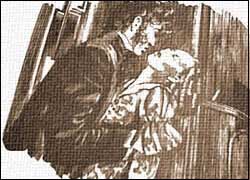
He didn't.
The idea of Heathcliff digging up Catherine's body is one of the best known myths about Wuthering Heights. Sometimes, it is said, he just embraces her, sometimes he even dances with her lifeless corpse. But the reality is very different.
The incidents with Catherine's body take place in chapters 16 (near the end) and 29 (about halfway).
In chapter 16, Heathcliff visits her body in her room at Thrushcross Grange and places a lock of his hair in her locket (my italics).
Mrs. Linton's funeral was appointed to take place on the Friday following her decease; and till then her coffin remained uncovered, and strewn with flowers and scented leaves, in the great drawing-room. Linton spent his days and nights there, a sleepless guardian; and—a circumstance concealed from all but me—Heathcliff spent his nights, at least, outside, equally a stranger to repose. I held no communication with him: still, I was conscious of his design to enter, if he could; and on the Tuesday, a little after dark, when my master, from sheer fatigue, had been compelled to retire a couple of hours, I went and opened one of the windows; moved by his perseverance to give him a chance of bestowing on the faded image of his idol one final adieu. He did not omit to avail himself of the opportunity, cautiously and briefly; too cautiously to betray his presence by the slightest noise. Indeed, I shouldn't have discovered that he had been there, except for the disarrangement of the drapery about the corpse's face, and for observing on the floor a curl of light hair, fastened with a silver thread; which, on examination, I ascertained to have been taken from a locket hung round Catherine's neck. Heathcliff had opened the trinket and cast out its contents, replacing them by a black lock of his own. I twisted the two, and enclosed them together.
In chapter 29, after her funeral, we find this:
He turned abruptly to the fire, and continued, with what, for lack of a better word, I must call a smile: 'I'll tell you what I did yesterday! I got the sexton, who was digging Linton's grave, to remove the earth off her coffin lid, and I opened it. I thought, once, I would have stayed there: when I saw her face again—it is hers yet!—he had hard work to stir me; but he said it would change if the air blew on it, and so I struck one side of the coffin loose, and covered it up: not Linton's side, damn him! I wish he'd been soldered in lead. And I bribed the sexton to pull it away when I'm laid there, and slide mine out too; I'll have it made so: and then by the time Linton gets to us he'll not know which is which!'
and this:
'Of dissolving with her, and being more happy still!' he answered. 'Do you suppose I dread any change of that sort? I expected such a transformation on raising the lid—but I'm better pleased that it should not commence till I share it. Besides, unless I had received a distinct impression of her passionless features, that strange feeling would hardly have been removed. It began oddly. You know I was wild after she died; and eternally, from dawn to dawn, praying her to return to me her spirit! I have a strong faith in ghosts: I have a conviction that they can, and do, exist among us! The day she was buried, there came a fall of snow. In the evening I went to the churchyard. It blew bleak as winter—all round was solitary. I didn't fear that her fool of a husband would wander up the glen so late; and no one else had business to bring them there. Being alone, and conscious two yards of loose earth was the sole barrier between us, I said to myself 'I'll have her in my arms again! If she be cold, I'll think it is this north wind that chills me ; and if she be motionless, it is sleep.” I got a spade from the tool-house, and began to delve with all my might—it scraped the coffin; I fell to work with my hands; the wood commenced cracking about the screws; I was on the point of attaining my object, when it seemed that I heard a sigh from some one above, close at the edge of the grave, and bending down. 'If I can only get this off,” I muttered, 'I wish they may shovel in the earth over us both!” and I wrenched at it more desperately still. There was another sigh, close at my ear. I appeared to feel the warm breath of it displacing the sleet-laden wind. I knew no living thing in flesh and blood was by; but, as certainly as you perceive the approach to some substantial body in the dark, though it cannot be discerned, so certainly I felt that Cathy was there: not under me, but on the earth. A sudden sense of relief flowed from my heart through every limb. I relinquished my labour of agony, and turned consoled at once: unspeakably consoled. Her presence was with me: it remained while I re-filled the grave, and led me home.
So it is clear from these extracts that Heathcliff never actually removes her body from the coffin and, on the visit to the drawing room, there is no suggestion that he even moves her body:
Indeed, I shouldn't have discovered that he had been there, except for the disarrangement of the drapery about the corpse's face…
The result then is that this is what happens to Catherine's body:
- Monday 20 March 1784. Catherine dies in the parlour at Thrushcross Grange (about two in the morning), aged about 18 years.
- Monday 20 March 1784. At sunrise, Edgar is found with his head on the pillow next to Catherine's.
- Tuesday 21 March 1784. Heathcliff enters the drawing room "a little after dark" (which would be about 1900). Catherine is in her coffin which is open. Ellen opens the windows and, sometime during the night, Heathcliff enters and replaces Edgar's hair with his in her locket. Ellen entwines Edgar and Heathcliff's hair in the locket.
- Friday 24 March 1784. Catherine's funeral in a corner of the chapel churchyard. Hindley and Heathcliff do not attend.
- Friday 24 March 1784. In the evening, Heathcliff goes alone to the churchyard with the intention of digging down to Catherine's coffin and holding her in his arms. But, as he is trying to lever off the lid, he senses Catherine's spirit and stops. He refills the grave and leaves.
- August/September 1801. Edgar is buried next to Catherine. While the grave was being dug, Heathcliff persuades/pays the sexton to remove the earth from her coffin and he opens it. He replaces it to prevent decomposition and removes the side of her coffin (away from Edgar's position) and covers it up.
- April (probably) 1802. Heathcliff is buried next to Catherine. Although not explicitly stated, the suggestion is that the side of his coffin and Catherine's were removed so that they lay together.
 Postscript
Note: it is interesting to note that Catherine dies on a couch in the parlour, not in her bedroom. Could this have been the source of the legend that Emily died on the couch in the Parsonage?
Is Heathcliff a murderer?
From "Is Heathcliff a Murderer? : Great Puzzles in Nineteenth-century Literature" by John Sutherland (Oxford World's Classics — Oxford University Press).
When he returns to Wuthering Heights after his mysterious three-year period of exile Heathcliff has become someone very cruel. He left an uncouth but essentially humane stable-lad. He returns a gentleman psychopath. His subsequent brutalities are graphically recorded. They are many and very unpleasant. He humiliates Edgar Linton who has married Cathy during his absence. 'I wish you joy of the milk-blooded coward', he tells Cathy in her husband's presence. The taunt is the more brutal since Edgar is clearly the weaker man and in no position to exact physical reparation. Heathcliff goes on to torment Edgar by hinting that he has cuckolded him. Subsequently Heathcliff beats his wife Isabella, as he has gruesomely promised to do in earlier conversation with Cathy: 'You'd hear of odd things, if I lived alone with that mawkish, waxen face; the most ordinary would be painting on its white the colours of the rainbow, and turning the blue eyes black, every day or two; they detestably resemble Linton's'.
When Nelly sees Isabella, after she has fled from Heathcliff, she does indeed describe 'a white face scratched and bruised'. Isabella goes on to describe her husband's 'murderous violence' to Nelly in some detail. Heathcliff has shaken her till her teeth rattle. He has thrown a kitchen knife at her head which 'struck beneath my ear'; she has a wound which will probably scar her for life. Had she not run away, who knows how far he would have gone in his cold brutality towards her.
In later life Heathcliff would certainly have beaten his son as savagely as he beat the boy's mother, were it not that he needs the degenerate brat whole and unmarked for his long-term scheme of revenge against Thrushcross Grange. He has no compunction about punching young Catherine. Young Heathcliff tells Nelly about his father's violent reaction on learning that the girl has tried to keep for herself two miniatures of her dead parents:
'I said they were mine, too; and tried to get them from her. The spiteful thing wouldn't let me: she pushed me off, and hurt me. I shrieked out—that frightens her—she heard papa coming, and she broke the hinges and divided the case, and gave me her mother's portrait; the other she attempted to hide: but papa asked what was the matter, and I explained it. He took the one I had away, and ordered her to resign hers to me; she refused, and he—he struck her down, and wrenched it off the chain, and crushed it with his foot.'
'And were you pleased to see her struck?' I asked: having my designs in encouraging his talk.
'I winked,' he answered: 'I wink to see my father strike a dog or a horse, he does it so hard.'
Or a woman, one may add. It is not just four-footed victims who feel the weight of Heathcliff's fist. Heathcliff is capable of more cold-blooded and calculating cruelty. He abducts young Catherine and keeps her from her dying father's bedside, accelerating Edgar's death and ensuring that it shall be an extremely miserable one. He urges Hindley towards self-destruction by encouraging his fatal mania for drink and cards. On a casual level, Heathcliff is given to killing household pets (he strangles his wife's favourite dog by way of wedding present) and desecrates graves.
Mr Heathcliff, we may assume, is not a nice man. And in a later age his violence and lawlessness would have earned him a prison sentence or at the very least a string of restraining orders and court injunctions. But does Heathcliff commit the cruellest crime of all, murder?
To answer this question we must examine the suspicious circumstances of the death of Hindley Earnshaw, master of Wuthering Heights. 'The end of Earnshaw was what might have been expected,' Nelly recalls in her long narrative to Lockwood, 'it followed fast on his sister's, there was scarcely six months between them. We, at the Grange, never got a very succinct account of his state preceding it.' Nelly learns of the death, after the event, from the local apothecary, Mr Kenneth. 'He died true to his character,' Kenneth cheerfully adds, 'drunk as a lord'. Hindley was just 27. Evidently Kenneth has witnessed, the death and signed the necessary certificate.
Nelly's suspicions are immediately aroused. 'Had he fair play?' she ponders. The anxiety 'bothers' her and she makes a trip to Wuthering Heights to discover what she can of the truth of the case. Before going she learns from Earnshaw's lawyer (who also acts for Mr Linton, Nelly's employer) that the 'whole property [of Wuthering Heights] is mortgaged' to Heathcliff. At the Heights, Nelly meets Heathcliff who, rather shiftily, as we may think, gives his eyewitness account of Hindley's death:
'Correctly,' he remarked, 'that fool's body should he buried at the cross-roads, without ceremony of any kind. I happened to leave him ten minutes yesterday afternoon, and in that interval he fastened the two doors of the house against me, and he has spent the night in drinking himself to death deliberately! We broke in this morning, for we heard him sporting like a horse; and there he was, laid over the settle: flaying and scalping would not have wakened him. I sent for Kenneth, and he came; but not till the beast had changed into carrion: he was both dead and cold, and stark; and so you'll allow it was useless making more stir about him!'
By the last enigmatic remark, Heathcliff means that it would have been 'useless' calling in the coroner, on the grounds that the death was suspicious.
Heathcliff's account is 'confirmed' to Nelly by Joseph, the misanthropic (but wholly reliable) old manservant at the Heights. Joseph, however, is by no means happy about his former master's last hours:
'I'd rayther he'd goan hisseln for t' doctor! I sud ha' taen tent o' t' maister better nor him—and he warn't deead when I left, naught o' t' soart!' ['I would rather that Heathcliff had gone himself for the doctor! I should have taken care of the master better than him and he wasn't dead when I left, nothing of the sort!'].
Joseph is invincibly honest. And one concurs in his 'muttered' doubts (he dare not voice them out loud, in case Heathcliff hears, and gives him the back of his hand). It is most improbable that a 27-year-old man, in otherwise robust health, should be able to 'drink himself to death' in a single night. Young men do, of course, kill themselves by excessive drinking, but usually by driving cars drunk, or by inhaling their own vomit while sleeping. It is clear that although he is 'snorting 'Hindley is breathing efficiently when he is left alone with Heathcliff. Did he show signs of being about to suffocate, it would be an easy thing for Heathcliff to lift him up and bang him on the back, thus clearing his throat. And, as Joseph recalls, although dead drunk, Hindley did not appear to be dying. He was, however, insensible and incapable of resisting anyone stifling him with a cushion. Kenneth is a somewhat elusive figure, but it is likely that as a mere apothecary ('Mr' Kenneth) he would not have been able to conduct any expert medical examination of the body. It may even be that Heathcliff bribed him to sign the certificate and obviate any embarrassing coroner's inquest.
It is nicely poised and every reader must make his or her own judgement. If Heathcliff did stifle Hindley (albeit that Hindley has earlier tried to shoot and stab Heathcliff) we have to see him as a sociopathic monster. If he watched the man die, and declined to prevent his death (by clearing Hindley's throat, for example) he is scarcely better. These plausible reconstructions of what happened at Wuthering Heights while Heathcliff and the incapable Hindley were alone together render absurd such rosy adaptations as the Samuel Goldwyn 1939 film. If we believe that Heathcliff was simply an innocent bystander at Hindley's self-destruction, then we can credit the sympathetic reading of his character suggested by the exclamation Nelly overhears him make, in the intensity of his wretchedness: 'I have no pity! I have no pity! The [more the] worms writhe, the more I yearn to crush out their entrails! It is a moral teething, and I grind with greater energy, in proportion to the increase of pain'.
When a baby savagely bites its teething ring, it is because it (the baby) is experiencing excruciating pain from the teeth tearing their way through its gums. So Heathcliff may be seen to inflict pain on others (hurling knives at his wife, taunting Edgar, striking young Catherine, lashing his horse) only because he feels greater inward pain himself. But one cannot so justify the furtive smothering, in cold blood, of someone whose death will mean considerable financial gain to the murderer. There are no clear answers to this puzzle. As Ian Jack has noted, 'Wuthering Heights is one of the most enigmatic of English novels'. Whether or not Heathcliff is guilty of capital crime remains a fascinating but ultimately inscrutable enigma at the very heart of the narrative. For what it is worth, I believe he did kill Hindley, although for any unprejudiced jury it is likely that enough 'reasonable doubt' would remain to acquit him.
Was Heathcliff Mr Earnshaw's son?
 The circumstances of Heathcliff's arrival at Wuthering Heights are certainly peculiar and this has led many people to speculate that there is more to the origins of the boy than Mr Earnshaw lets on. The idea of Mr Earnshaw walking for three days to Liverpool and back (when he had horses in the stable) seems unusual to the modern mind when we are so used to driving everywhere but maybe that was quite normal in those days. (And Emily certainly wouldn't have turned her nose up at a long walk.)
But this journey has made people suspect that his visit to Liverpool (or indeed somewhere else if he is not telling the whole truth) is a cover for something more ― an illicit affair with a gypsy woman. The suggestion made is that he had been visiting this woman for some time and Heathcliff is the result of their liaison. This explains why he would return with a strange child and why he ended up favouring him over his "real" son, Hindley.
There is no clear indication one way or the other in the book and I would suspect that Emily would have dropped in some hints if she had really intended Heathcliff to be Mr Earnshaw's child. In the end, the evidence is circumstantial and there is no way of deciding the matter.
I personally am inclined to believe that Mr Earnshaw was telling the truth and he had simply come across Heathcliff alone and starving in the streets. And there is one little piece of evidence that tends to support this. When Heathcliff arrives, Nelly explains that "it only stared round, and repeated over and over again some gibberish that nobody could understand." Now Heathcliff is about seven at this time so we must assume the liaison had been going on for at least eight years. Presumably his mother speaks English since it is hard to imagine such a long relationship between two people who could not communicate and yet Heathcliff has learned nothing of that language in his childhood. It seems much more reasonable to accept that he (and maybe his mother) had, for example, grown up abroad and arrived at Liverpool by ship. With no knowledge of English, we can understand how he could have been found destitute by Mr Earnshaw. Maybe the man rescued him from some attack and felt obliged to look after him afterwards (or indeed the other way around). Whatever it was, it turned out to be a misguided and portentous act.